
From ancient sentinels to future giants, here are the trees that tell Melbourne’s story at Royal Botanic Gardens Victoria.
Long before Melbourne's skyline soared above the Birrarung (Yarra River), Eucalyptus camaldulensis (River Red Gum), with its winding branches, brilliant red trunks and silver-green leaves, framed the river corridor. Today, a handful of these significant survivors stand alongside remarkable trees that arrived with early settlers, visionary botanists and visiting royalty. Together, they tell the story of Melbourne through nearly two centuries of living history.
Established in 1846, Melbourne Gardens is home to more than 5,500 trees representing around 1,300 different taxa. Together they form one of Australia's most significant tree collections, linking Indigenous, colonial, scientific and horticultural histories through a single living landscape.
The oldest stories belong to the Gardens' remnant River Red Gums, known as the Ancient Sentinels. These trees pre-date European settlement and may be several hundred years old. They are survivors of the original landscape that once lined the Birrarung, when River Red Gums stretched across the floodplain where Melbourne now stands.
For Arborist and Eucalypt Curator, James (Jim) Shugg, they are among the most important trees in the collection.
James (Jim) Shugg, Arborist and Eucalypt CuratorThese trees connect us to a landscape that existed before the city. They're culturally significant, ecologically significant and they help tell the whole story of this place.
Unlike younger trees, ancient specimens develop features that can take centuries to form. In the case of the eucalypts, hollows that are suitable for occupancy by fauna typically only develop when the tree has reached a considerable age, often more than a century. In addition, their vast root systems and complex canopies can support entire ecosystems. The Gardens manages these trees with a retention-first philosophy, recognising their value as living links between First Nations history, colonial history and contemporary Melbourne.
Not far away one of Arthur’s Elms remains.
Planted in 1846 by John Arthur, the Gardens' first superintendent, they mark the beginning of Melbourne's formal botanic collection. Arthur was a Scottish-trained landscape gardener who arrived in Port Phillip in 1839 and was appointed by Charles La Trobe to establish the new Botanic Gardens. He lived and worked on the site, laying out the original gardens, planting the Lagoon Walk and carefully incorporating existing Indigenous vegetation into the landscape. Arthur died in 1849 at his official residence within the Gardens, just three years after beginning the work that would shape one of Melbourne's most treasured places.
Peter Berbee, Arborist and Oak Collection CuratorThey're among the founding trees of Melbourne Gardens. When you stand beneath them, you're standing where the story of the Gardens began.
Their significance extends beyond Victoria. Mature English elms have become increasingly rare internationally following the devastation of Dutch elm disease across much of the Northern Hemisphere, giving Arthur's surviving trees exceptional heritage value.
The next chapter belongs to Ferdinand Von Mueller and William Guilfoyle. These visionary directors transformed Melbourne Gardens into the picturesque landscape visitors know today. Guilfoyle also believed botanic gardens should be beautiful, but also useful, and many of his plantings reflected the economic ambitions of the colony.
Near Eastern Lodge grows an old olive tree believed to have been planted by Von Meuller. In the nineteenth century, olives were seen as a potential industry for Victoria, valued not only as a source of food but also for commercial production. Guilfoyle experimented with olive oil production from various varieties growing in the Gardens and submitted his olive oil into horticultural competitions, as well as supplying plants and cuttings to farmers, settlers and others likely to take an interest in their cultivation in all parts of Victoria
Today, it tells another story. As climate change places increasing pressure on olive-growing regions around the world, the genetics preserved within historic trees such as these may become increasingly important.
The same spirit of experimentation can be found in the Gardens' oldest cultivated tree.
Dr Godfrey Howitt's date palm (Phoenix dactylifera) was first planted in his Collins Street garden in 1839 before being relocated to Melbourne Gardens in 1883. It is believed to be the oldest cultivated tree in the collection and serves as a living link to Melbourne's earliest years. Like the olive tree, it reflects a period when botanic gardens showcased plants with practical value as well as ornamental appeal. Date palms produce the edible dates enjoyed around the world today and represented another species with agricultural and economic potential for the growing colony.
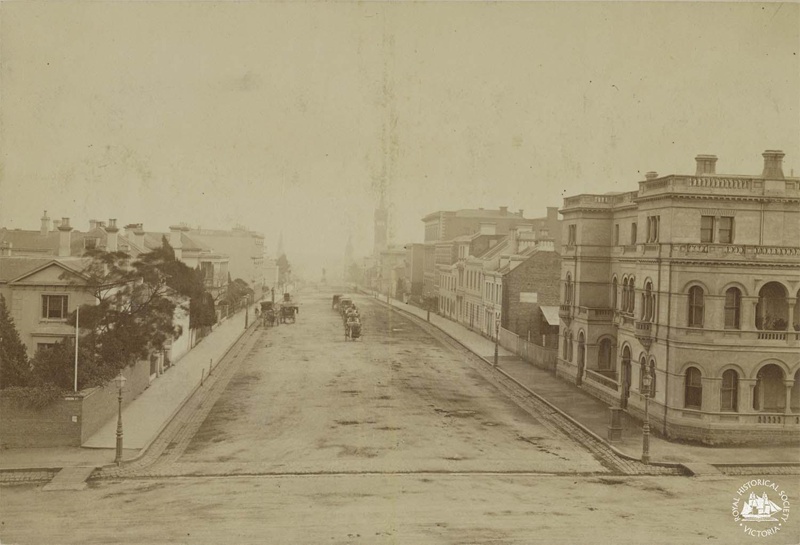
Collins Street East, c. 1875. Dr Godfrey Howitt's garden on the left. Courtesy Royal Historical Society of Victoria.
Remarkably, the tree is still contributing to science.
Recently, researchers investigating a tiny pollinating thrips associated with male date palm flowers made a discovery believed to be the first recorded occurrence of the species in Australia. Nearly two centuries after it first took root, the tree continues to provide new insights for botanists.
If the date palm represents one of the oldest cultivated stories in Melbourne Gardens, the newest story is just beginning.
Earlier this year, a Huon Pine was planted to commemorate the visit of Their Majesties King Frederik and Queen Mary of Denmark. Endemic to lutruwita/Tasmania, the species is one of Australia's oldest and most significant trees. Some individuals can live for up to 3,000 years and grow as little as one millimetre each year. Now threatened in the wild, it stands as a powerful symbol of resilience, longevity and conservation. The planting holds particular significance given Queen Mary's Tasmanian heritage, creating a lasting connection between her homeland and the Gardens.
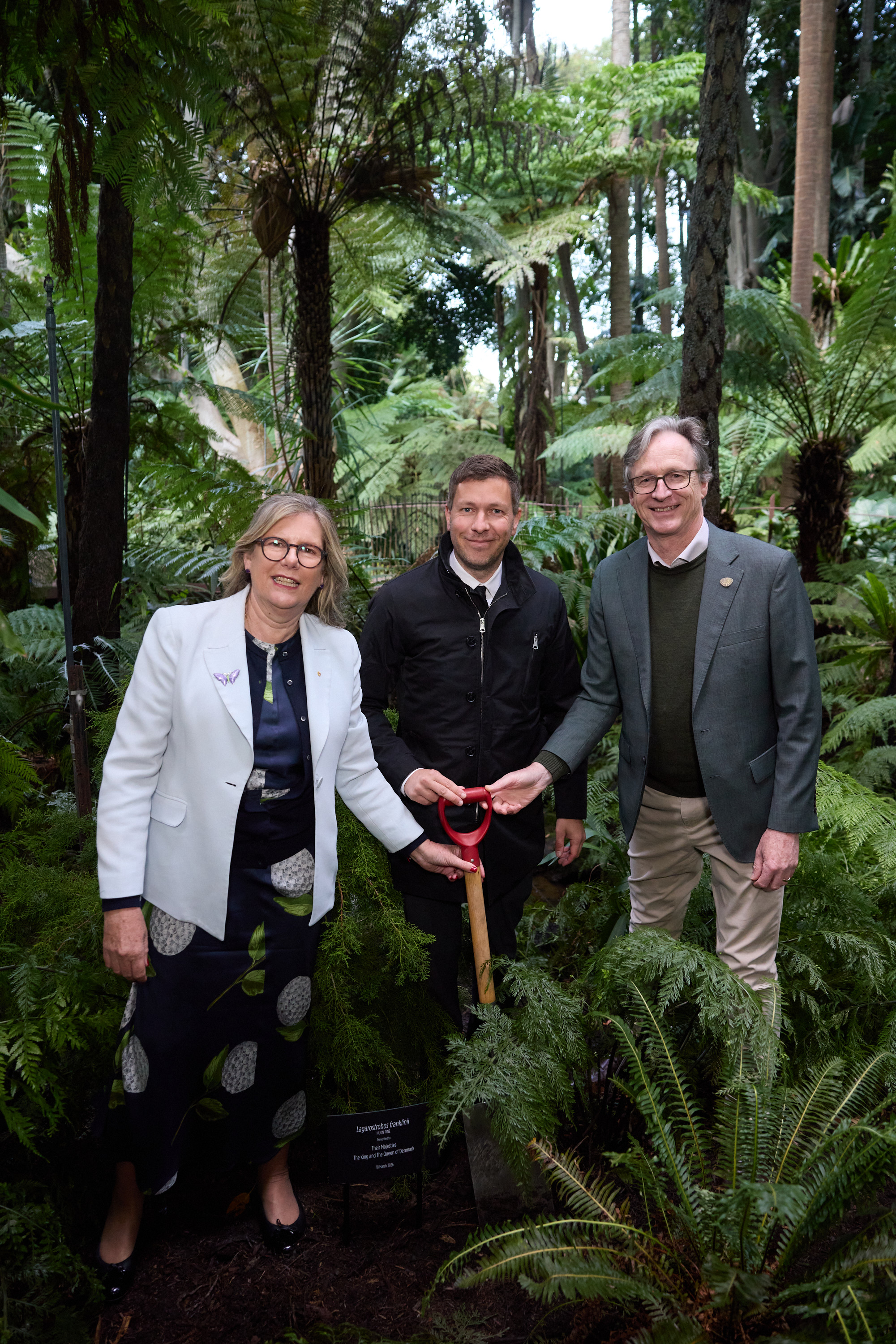
Penny Fowler, Chair Royal Botanic Gardens Victoria Board, Flemming Anderson, Deputy Head of Mission, Royal Danish Embassy and Chris Russell, Director & Chief Executive, Royal Botanic Gardens Victoria planting a Huon Pine 2026.
The Huon Pine joins a growing collection of commemorative trees planted throughout the landscape. Trees have been planted to honour Queen Elizabeth II, Charles La Trobe, Dame Nellie Melba, Nick Cave, the Gardens' volunteer guides and the Wurundjeri Woi-wurrung Traditional Owners through a Warun manna gum. Each adds another layer to Melbourne Gardens' living story.
As Melbourne Gardens approaches its 180th year, caring for that story is becoming increasingly complex as climate change places new pressures on the collections. In response, arborists carefully map the life expectancy of the collection, balancing the care of historic veterans with the establishment of future generations.
For Director & Chief Executive Chris Russell, the challenge is both practical and deeply meaningful.
Chris Russell, Director & Chief ExecutiveEvery tree here represents a decision made by someone who wanted to leave something for future generations. Our role is to honour that legacy while ensuring the next generation of trees can thrive for the next 180 years.
Perhaps that is the wonder of Melbourne Gardens. Beneath a canopy that can make the Gardens feel up to two degrees cooler than the surrounding city on a summer day, visitors can walk among centuries of history while imagining centuries still to come.
This anniversary year, wander beneath the towering veterans, seek out the trees that helped shape Melbourne's story, marvel at the young trees just beginning theirs, and add your own chapter to this remarkable place.


Background Information
To source images and interviews, please contact:
communications@rbg.vic.gov.au
(03) 9252 2300